Sivolo reads a conversation you already have and analyses it against the UK Legal Framework for Controlling & Coercive behaviour. Your messages are encrypted in transit and never retained on our servers. When a longer analysis runs in the background, your finished result is held only briefly — encrypted so only you can open it — then delivered to your device and deleted from our servers. Every finding stays tied to a real, time-stamped message.
Use your phone’s built-in export to save a chat from WhatsApp or Android SMS, or simply paste the text — including from iMessage.* Long histories are handled automatically by splitting them into date ranges.
* Note on iMessage: iMessage has no one-tap chat export. You can copy and paste messages straight into Sivolo, or use a reputable third-party export utility to produce a text file. WhatsApp and Android SMS both export natively from the app.
Tell Sivolo who is who, the type and length of relationship, and any key dates or incidents. Context sharpens the analysis but is never required, and is stored only on your device.
The conversation is assessed against Section 76 of the Serious Crime Act 2015 and CPS statutory guidance on coercive and controlling behaviour. Large logs are read in passes, then reconciled into one picture. This runs on Sivolo’s secure backend so you can close the app and come back to a finished result. Your messages are processed in memory and never retained; the finished result is encrypted so only you can open it, held briefly until you collect it, then deleted from our servers.
A longer analysis keeps running on our secure backend even if you close the app or lose signal. Come back whenever suits you and collect the finished result — it’s sealed so only your device can open it. You’re notified when it’s ready only if you opt in; notifications stay off by default, for your safety.
Findings are grouped into four evidence lenses with the exact messages, timestamps and a plain-English explanation of why each one matters. You can add notes, see surrounding context, and flag anything.
A built-in education library explains coercive control, reactive abuse, trauma bonding and recovery in plain language — curated, not generated, so you can trust what you read.
Produce a professional PDF report for police, an IDVA or a solicitor — or securely share specific findings with a trusted contact. You stay in control of who sees what, and can revoke access at any time.
Coercive control is a single pattern, but the law asks several different questions about it. Sivolo answers each one separately so the picture is complete — and so the same message is never double-counted.
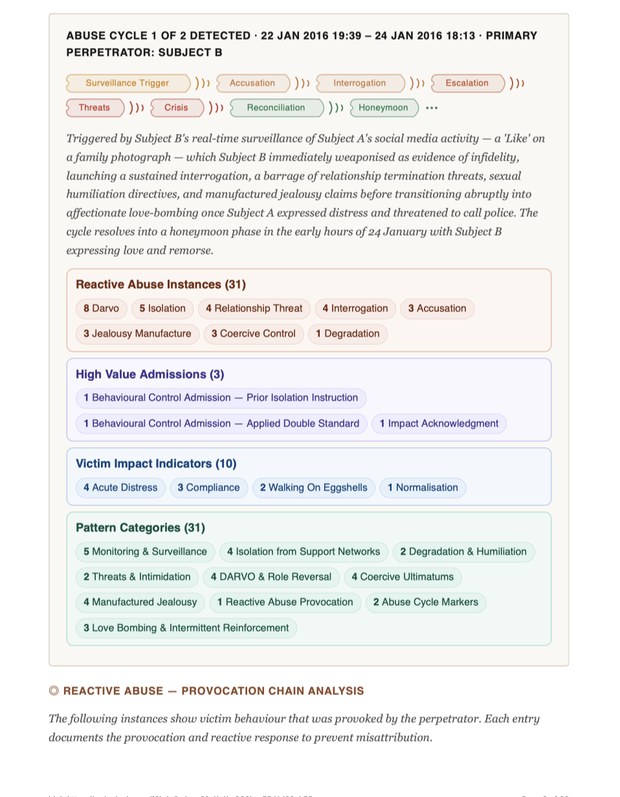
Shows the other party’s provocation — a threat, an accusation, a coercive demand — paired side by side with your response. This protects a defensive reply from being read in isolation and misused as “evidence” you were the aggressor.
Surfaces moments where the other party admits intent, awareness or control — “I did it to punish you”, “I knew that would hurt you”, “you’re not allowed to see them.” Direct evidence, in their own hand.
Identifies fear, compliance, walking-on-eggshells language and normalisation — the cumulative psychological harm that the law treats as the serious effect at the heart of the offence.
Scores established patterns — monitoring, isolation, degradation, threats, DARVO, coercive ultimatums, manufactured jealousy, love-bombing — by how pervasive each one is across the whole history.
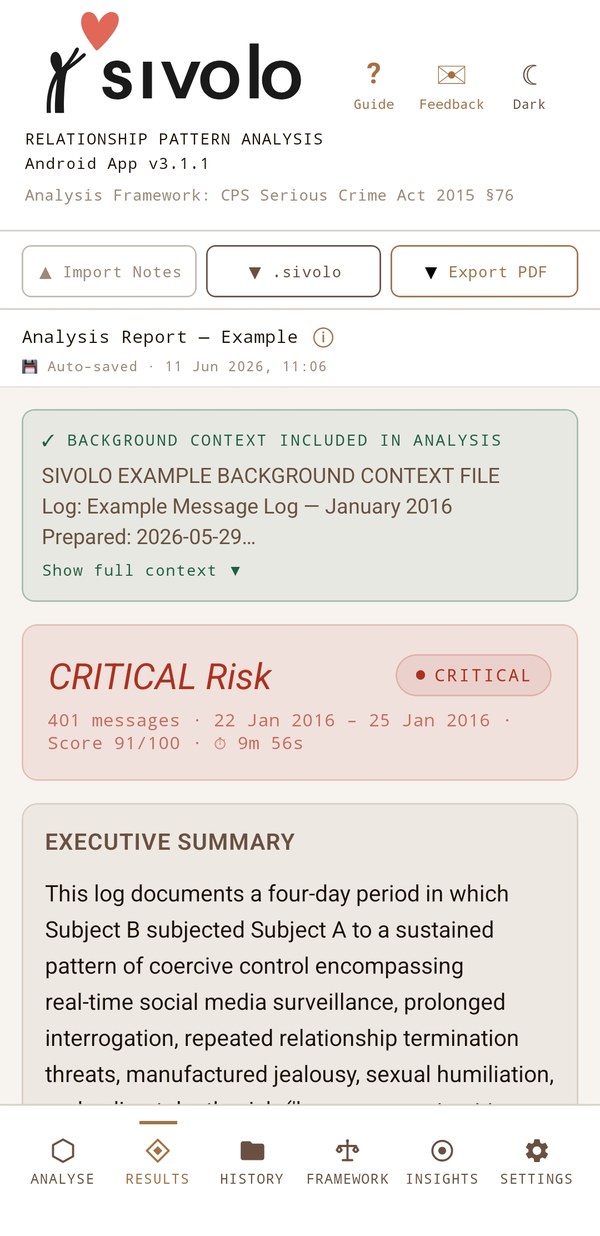
Each pattern category is scored from 0–100 based on how often it appears and how serious each instance is — not a simple count. Two conversations of the same length can score very differently.
An overall risk level reflects the strongest categories — and where several independent patterns each reach High, the sustained, multi-strand nature of the control is itself treated as a serious-harm signal.
The pattern categories are drawn from the Crown Prosecution Service statutory guidance on Controlling or Coercive Behaviour — the same framework police and prosecutors use to assess these offences in England & Wales — so every result maps to a recognised legal reference point.
Sivolo organises and evidences material against the legal framework. It does not reach legal conclusions or diagnose anyone — that remains for qualified professionals and the courts.
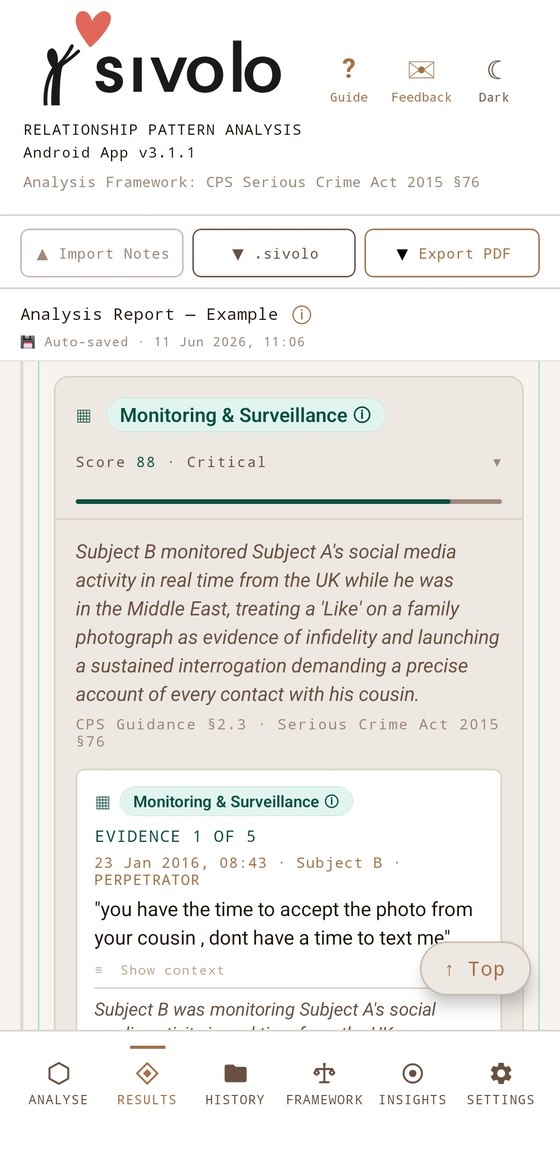
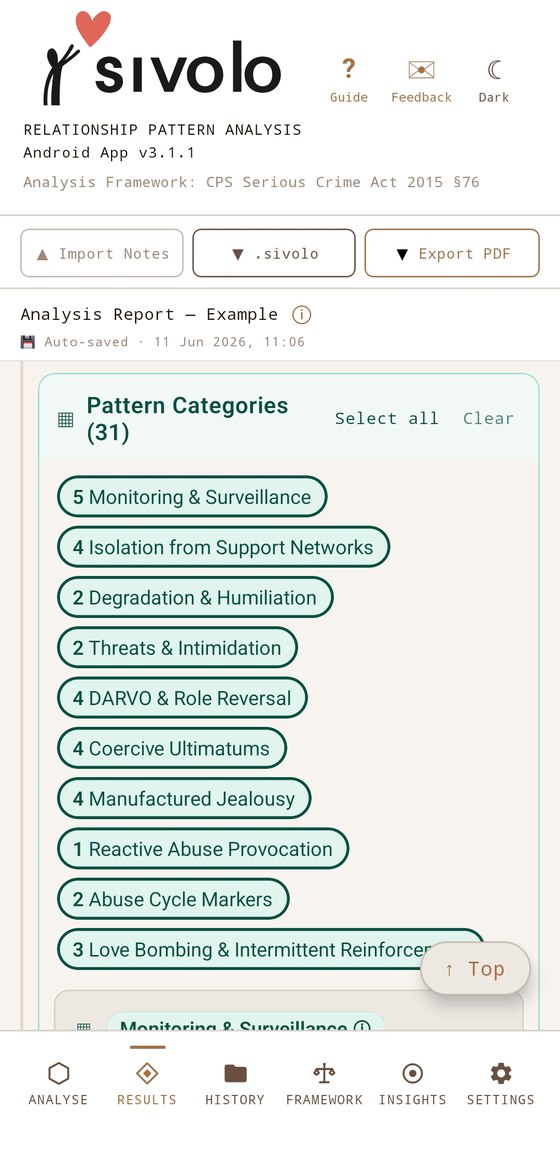
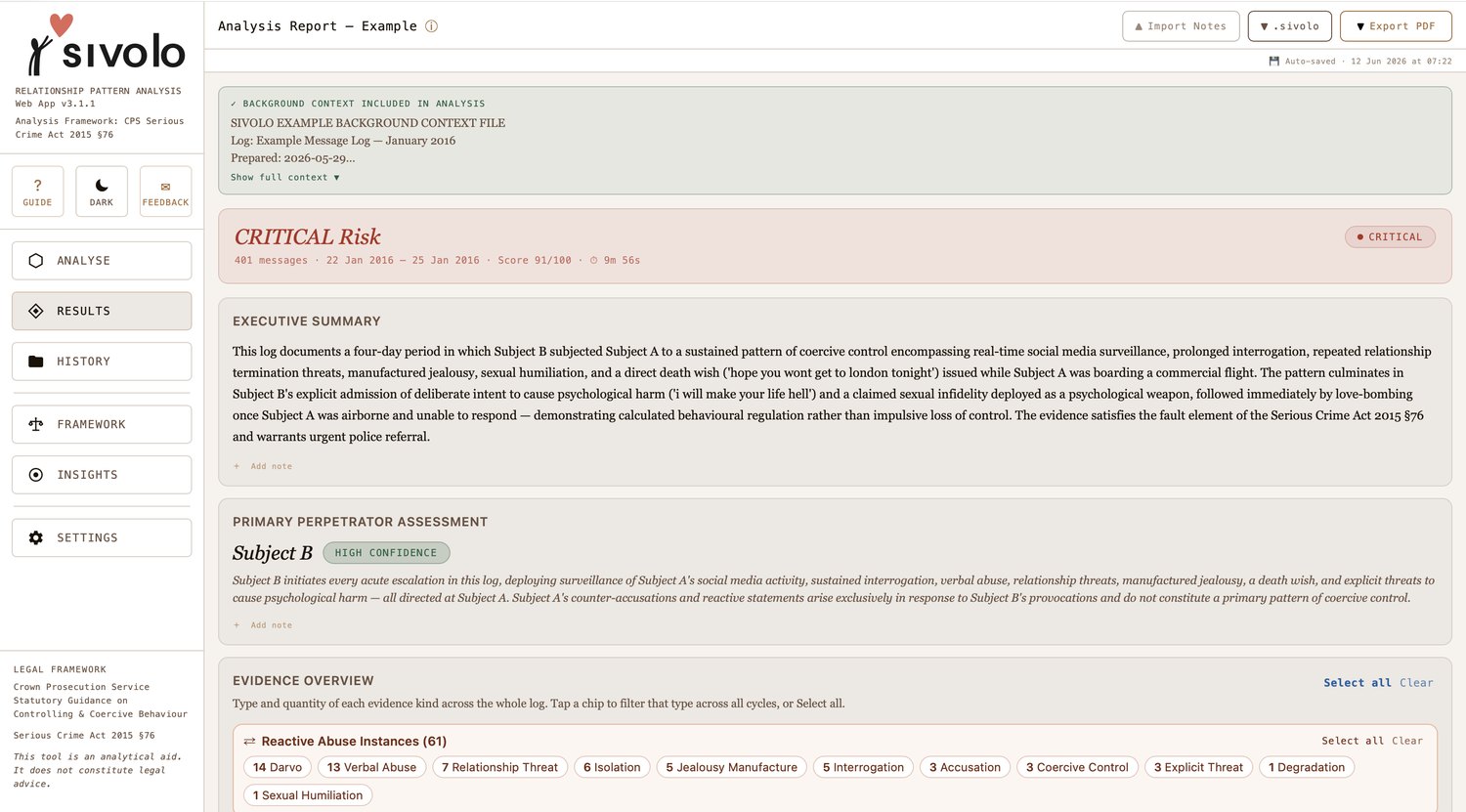
Actual app screens · example data
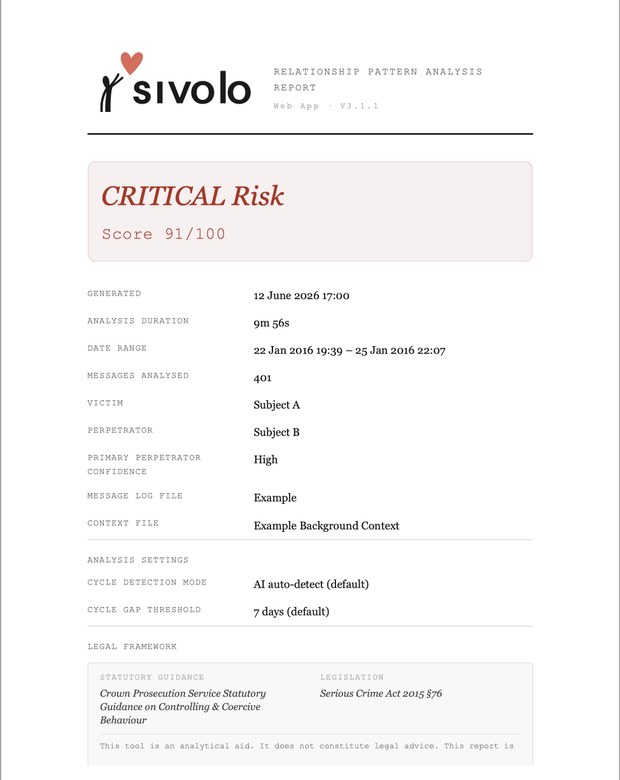
When you’re ready to act, Sivolo produces a professionally formatted PDF designed for police, IDVAs and solicitors — clear enough to read quickly, rigorous enough to stand up to scrutiny.


Actual PDF report · example data
One product, the same features, across the devices you already use.

Actual app screens · example data
Native app with Face ID / Touch ID unlock and the full set of privacy safeguards. Available on the App Store.
Native app with fingerprint, pattern or PIN unlock, and direct sharing from WhatsApp. Available on Google Play.
The full experience in your browser at web.sivolo.app — useful for working with longer exports on a larger screen.
Coercive control is a pattern of behaviour used by one person to dominate another, through isolation, monitoring, intimidation, degradation, threats or control of everyday life. Unlike a single incident, it is the repeated, cumulative pattern that causes harm. In England and Wales it is recognised in law as controlling or coercive behaviour in an intimate or family relationship.
Yes. Controlling or coercive behaviour in an intimate or family relationship is a criminal offence under Section 76 of the Serious Crime Act 2015 in England and Wales. The Crown Prosecution Service publishes statutory guidance on how the offence is assessed and prosecuted.
Because coercive control is a pattern rather than a single event, evidence usually means showing repeated behaviour over time, often through message histories, with each example tied to a date and to a recognised category of controlling behaviour. Sivolo analyses a conversation you already have against the CPS framework and organises the findings into a clear, time-stamped report you can share with police, an IDVA or a solicitor.
Reactive abuse describes a defensive or emotional reaction from someone who is being provoked or controlled, which can then be misrepresented as if they were the aggressor. Sivolo surfaces the other party's provocation alongside the response, so a reaction is not read in isolation.
Sivolo is built around your safety and privacy. You can use it without giving your name or email, your messages are encrypted in transit and never retained on our servers. When a longer analysis runs in the background, your finished result is held only briefly — encrypted so only you can open it — then delivered to your device and deleted from our servers. You stay in control of who sees any report.
Yes. Sivolo produces a professionally formatted PDF report, with an overall summary, quoted and time-stamped messages, and each finding mapped to the relevant point of the CPS framework, designed to be shared with police, IDVAs and solicitors.
No. Sivolo organises and evidences material against the legal framework; it does not diagnose anyone or reach legal conclusions. Those judgments remain for qualified professionals and the courts.
Sivolo is not a crisis service. If you are in immediate danger, call 999. In the UK, the free 24-hour National Domestic Abuse Helpline is 0808 2000 247.
Start free with the education library and your first analyses — stay as anonymous as you choose. We never keep your messages, and your results are stored only briefly, encrypted so only you can open them.